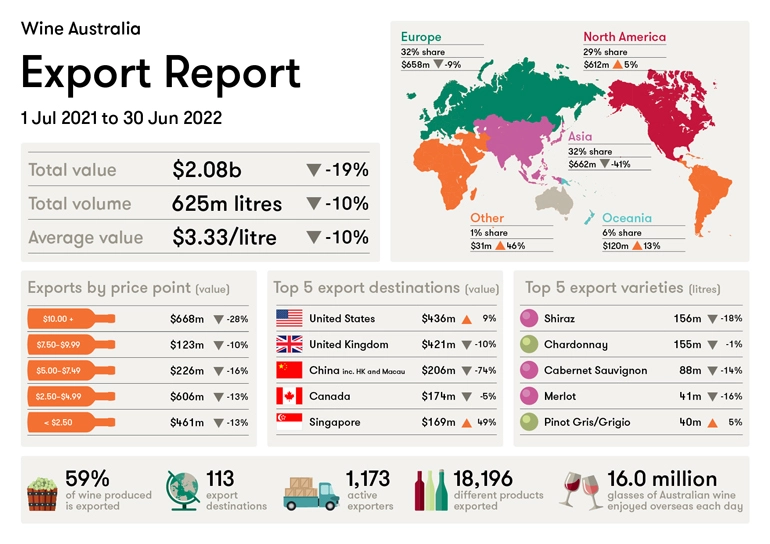


Australian wine exports declined by 10 per cent in volume to 625 million litres and 19 per cent in value to $2.08 billion in the year ended 30 June 2022, according to Wine Australia’s latest Export Report released today.
The decline in volume and value was not unexpected, as it was largely the result of the continued impact of the significant reduction in exports to mainland China, driven by high deposit tariffs imposed in November 2020. This is expected to remain a significant influence on the moving annual total data of Australian wine exports until late 2022.
During the 2021–22 financial year, the operating environment for many Australian wine exporters had been extremely challenging with the significant decline in exports to mainland China, the ongoing impact of the pandemic – including severe shipping delays and increased freight costs – and rising inflation, business costs and interest rates.
Wine Australia Manager, Market Insights, Peter Bailey said that while the total data showed declines, there were some encouraging signs in key and emerging markets.
“When mainland China is excluded from the data, exports increased by 5 per cent in value to $2.06 billion, an increase of $105 million – the highest value since 2009–2010. This is despite volume declining by 3 per cent to 619 million litres. The value growth for these markets was driven by a 9 per cent increase in average value to $3.32 FOB per litre,” he said.
“The key contributors to the value growth included Singapore, the United States (US), Malaysia, Thailand, India and New Zealand.
Figure 1: Value of Australian exports over time – mainland China and Rest of the World

“In the markets that experienced value growth, this was largely driven by exports in the higher value segments, particularly at $10 or more FOB per litre. This reflects the wine sales trends in many markets around the globe, which have seen a downward trend in commercial/value sales (less than US$10 per bottle retail) and sales growth in premium and above segments (US$10 or more per bottle retail).
“The above $10 or more FOB per litre price segment helped drive overall value growth to the US, which has returned to Australia’s top destination by value, and there was also a significant increase in the number of companies exporting to the US.”
In 2021–22, Australian wine exporters shipped wine to 113 destination markets. At a region-level, the most significant growth came from exports to Southeast Asia, up 51 per cent to $314 million, but also to North America, up 5 per cent to $612 million, and the Middle East, up 48 per cent to $20 million. This growth was offset by a decline in exports to Northeast Asia (including mainland China), down 64 per cent to $328 million, and Europe, down 9 per cent to $658 million.
Excluding mainland China, there was growth in exports in all price segments at $5 or more FOB per litre, except at the top segment of $200 or more per litre. The strongest growth came at $10 or more per litre, up 32 per cent to $658 million. Markets from all parts of the world contributed to growth in this price segment, including key markets within Southeast Asia, North America, Europe and Northeast Asia.
“Still red wine accounted for 92 per cent of the value of exports at $10 or more FOB per litre. This is critical as the reduction in exports to mainland China was predominantly still red wine. Off much smaller bases, still white wine and rosé also grew strongly in this price segment,” Mr Bailey said.
The value of wine exported in glass bottles decreased by 21 per cent to $1.57 billion in the past financial year while the average value per litre decreased by 8 per cent to $6.69 FOB per litre. Volume decreased by 14 per cent to 233 million litres. Mainland China was the main contributor to the decline in exports in glass bottles. Excluding mainland China, exports in glass bottles to the rest of the world increased in value by 11 per cent to $1.55 billion, volume by 1 per cent to 232 million litres and the average value by 10 per cent to $6.67 FOB per litre.
Unpackaged wine exports decreased by 13 per cent in value to $500 million and decreased 7 per cent in volume to 384 million litres. The average value of unpackaged wine decreased by
6 per cent to $1.30 FOB per litre. A decline in the volume of unpackaged exports to the United Kingdom (UK) and, to a lesser extent, Germany and the Netherlands, more than offset increases to the US, Canada and New Zealand.
In 2021–22, still red wine exports decreased by 26 per cent in value to $1.39 billion, while still white wine exports increased by 7 per cent to $579 million. The decline in red wine exports was driven by mainland China and to a lesser extent, the UK. For white wine, destinations in growth included the US, UK and Canada.
The top five markets by value were:
- US, up 9 per cent to $436 million
- UK, down 10 per cent to $421 million
- Canada, down 5 per cent to $174 million
- Hong Kong, down 9 per cent to $170 million, and
- Singapore, up 49 per cent to $169 million.
The top five markets by volume were:
- UK, down 15 per cent to 227 million litres
- US, up 10 per cent to 139 million litres
- Canada, up 4 per cent to 53 million litres
- New Zealand, up 13 per cent to 32 million litres, and
- Germany, down 11 per cent to 32 million litres.