


In the 12 months ended March 2025, Australian wine exports increased by 41 per cent in value to $2.64 billion and by 6 per cent in volume to 647 million litres, according to Wine Australia’s Export Report released today. The average value of exports increased by 33 per cent to $4.09 per litre free on board (FOB), the highest average value in almost two decades.
The increase in average value is mainly due to the elevated level of premium wine shipments to mainland China, after tariffs on Australian bottled wine were removed at the end of March 2024. The 12 months ended March 2025 represented a full year’s worth of exports to mainland China since the tariffs were eliminated – resulting in 96 million litres of exports to the market, valued at $1.03 billion. Mainland China now represents 39 per cent of total export value, but 15 per cent of volume.
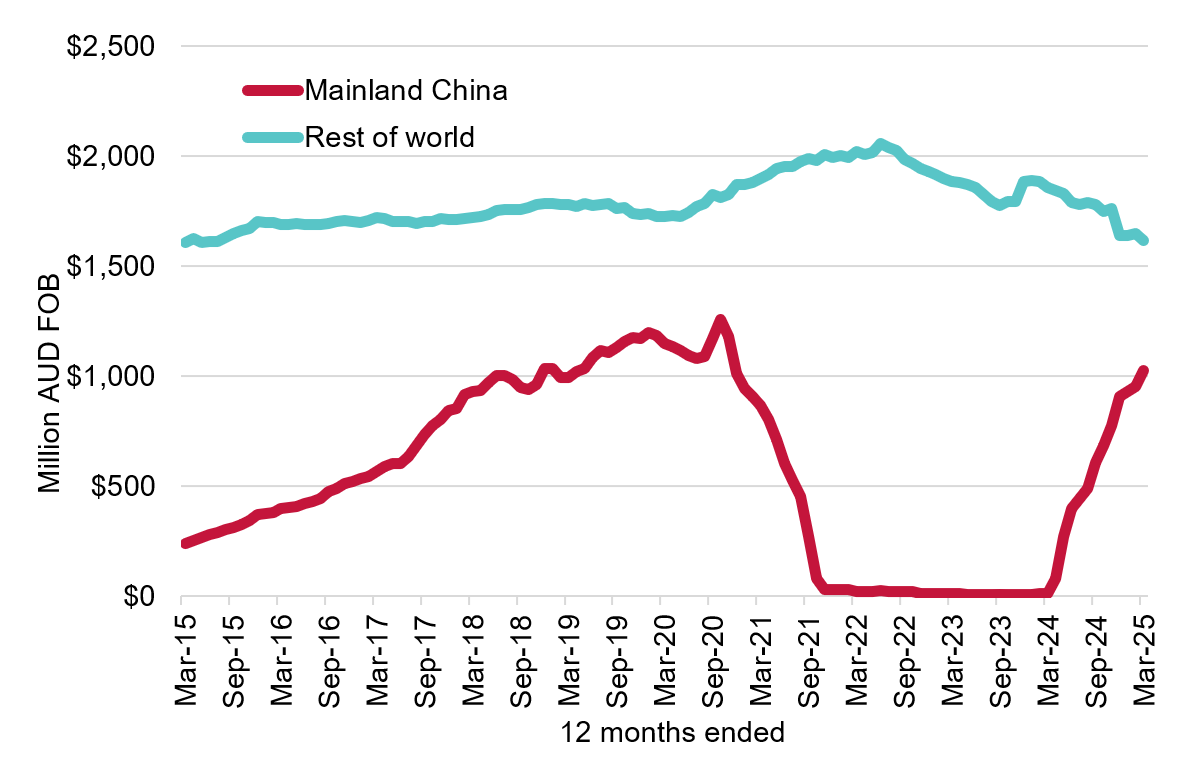
Exports to the rest of the world (excluding mainland China) declined by 13 per cent in value to $1.62 billion and 9 per cent in volume to 551 million litres. This was the lowest value to the rest of the world in ten years (see Figure 1) and lowest volume in over twenty years. While the decline in value was mainly driven by Hong Kong, the volume drop was due to declines in exports to key destinations such as the United Kingdom (UK), United States (US), and Canada.
Figure 1: Australian wine export value, mainland China vs rest of world
Outside of the unique circumstances relating to Australian wine exports to mainland China, the global wine market is facing considerable headwinds which are impacting on results to other markets and are unlikely to be resolved in the near-term. While there has been a long-term trend of consumers drinking less alcohol due to health and wellness concerns, more recent cost-of-living pressures could continue, or potentially get worse in certain markets, given current economic and geopolitical volatility. Escalating trade wars have the potential to increase prices, complicate supply chains, and rapidly change the competitive landscape in key wine markets in the near-term.
Australian wine was exported to 120 destinations in the year ended March 2025, up from 114 in the previous 12 months.
Figure 2: Australian wine exports by region (Million litres)
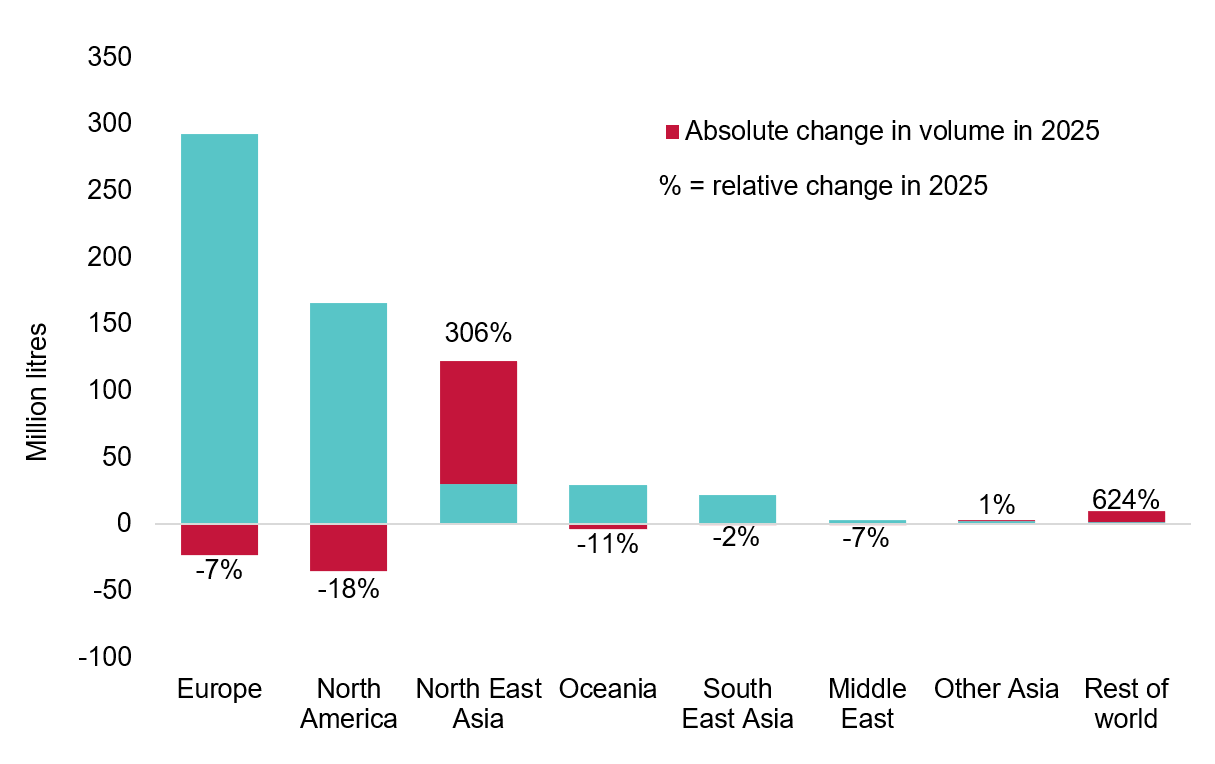
The largest region by volume for Australian wine exports was Europe, receiving 292 million litres of wine worth $515 million in the 12 months ended March 2025. Exports to Europe declined by 7 per cent in volume, mainly driven by a decline in exports to the UK.
Exports to North America declined by 18 per cent in volume to 166 million litres, valued at $476 million. While shipments to the US and Canada both declined in volume, Canada increased in value due to an increase in premium packaged shipments.
Shipments to Northeast Asia increased by 92 million litres (306 per cent) to 122 million litres. Value increased by $870 million to $1.28 billion. This increase was driven by exports to mainland China, although some of the growth was offset by a decline in exports to Hong Kong.
The top five destinations by value were:
- Mainland China (up $1.01 billion to $1.03 billion)
- UK (down $12 million to $353 million)
- US (down $32 million to $323 million)
- Hong Kong (down $136 million to $154 million), and
- Canada (up $3.8 million to $151 million).
The top five destinations by volume were:
- UK (down 19 million litres to 208 million litres)
- US (down 21 million litres to 106 million litres)
- Mainland China (up 94 million litres to 96 million litres)
- Canada (down 14 million litres to 60 million litres), and
- New Zealand (down 3.5 million litres to 26 million litres).
Mainland China
In the 12 months ended March 2025, Australian wine exports to mainland China increased by 94 million litres in volume to 96 million litres and $1.01 billion in value to $1.03 billion. The average value of shipments to mainland China was $10.65 per litre FOB, the highest average value in the top 10 markets by volume.
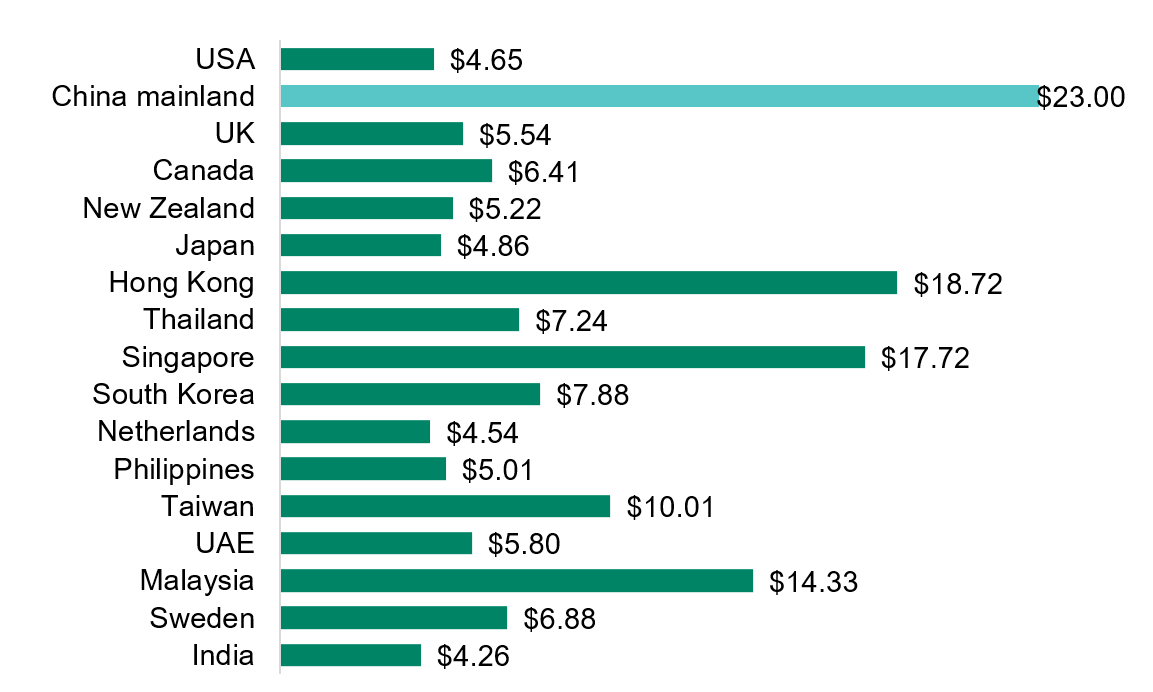
This average value is a result of a comparatively high level of premium wine shipments into the market. The average value of packaged wine shipped to mainland China in the year ended March 2025 was $23.00 per litre, much higher than any other major export market (see Figure 3). There were 41 million litres of packaged exports (mostly in glass bottle) shipped to China during the last 12 months, worth $955 million. This represents a 43 per cent share of volume and a 93 per cent share of value to the market. Meanwhile, 55 million litres of unpackaged exports were shipped (a 57 per cent volume share), worth $73 million (7 per cent of total value).
Figure 3: Average value per litre of packaged shipments
(markets listed in order of volume)
While the total value of shipments to mainland China is now at a similar level to the years immediately before tariffs on Australian bottled wine came into force, volume in the last 12 months is 23 per cent smaller than the 5-year average between 2016 and 2020 and 44 per cent below the peak in 2018. The lower volume reflects that the total wine market in China has declined by 68 per cent over the last five years, from 146 million 9-litre cases in 2018 47 million in 2023 [1].
United Kingdom
In the 12 months ended March 2025, Australian wine exports to the United Kingdom (UK) declined by 8 per cent in volume to 208 million litres and 3 per cent in value to $353 million. Average value increased by 6 per cent to $1.70 per litre FOB.
The UK is Australia's largest export market by volume, owing to Australia’s strong position in the UK off-trade market and the presence of large bottling facilities packaging wine, which in some cases then gets re-exported to other European markets. Although inflation has eased, consumers in the UK are still cautious with their spending on discretionary goods and most alcohol categories are suffering as a result. Wine sales dropped by 4 per cent in volume in the UK off-trade in the 12 months ended December 2024. Meanwhile, the average price of wine increased by 4 per cent to £6.79 per bottle[2] .
The number of exporters shipping to the UK increased to 314 businesses, up by 23 from the previous 12 months. Of the top 20 exporters by value, 15 experienced a growth in export value in the past year.
United States
In the 12 months ended March 2025, Australian wine exports to the United States (US) declined by 17 per cent in volume to 106 million litres and 9 per cent in value to $323 million, making it Australia’s second largest market by volume and third largest market by value.
On 2 April 2025, US President Trump announced tariffs on all importing countries, including Australia. Australian wine is now (at the time of writing) subject to a 10 per cent tariff on arrival in the US, while wines from the European Union are also subject to a 10 per cent tariff after Trump announced a 90 day pause on the initially higher tariffs on the EU. Because there are a number of factors to account for – how much of the increased cost importers will pass on to consumers, the effect of a global trade war on foreign exchange rates, and whether consumers will start to switch to domestic wines – it is hard to predict how this will affect Australian wine exports to the US in the short-to-medium term.
For more information, refer to Wine Australia’s Export Report and Export Dashboard.


