



The United Kingdom is Australia’s number one export market by volume and Australian wine is well known in the market, especially in the off-premise. As such, Australian wine’s performance in the market is closely tied to the large-scale factors impacting the market – such as inflation and declining disposable income, increasing alcohol duties, and declining wine consumption per person. Wine Australia’s newly released UK Market Update report provides a detailed analysis of these trends for current and prospective Australian wine exporters. This Market Bulletin will highlight key parts of the report.
Total inflation easing, though disposable incomes still low
The United Kingdom’s economy has had a turbulent time through the pandemic period and in its aftermath. It is the sixth largest global economy after the United States, China, Japan, Germany, and India and was not isolated from the global effects of the COVID-19 pandemic. The gross domestic product (GDP) declined by 10 per cent year-on-year in 2020 and subsequently rebounded to grow by 9 per cent in the next year.
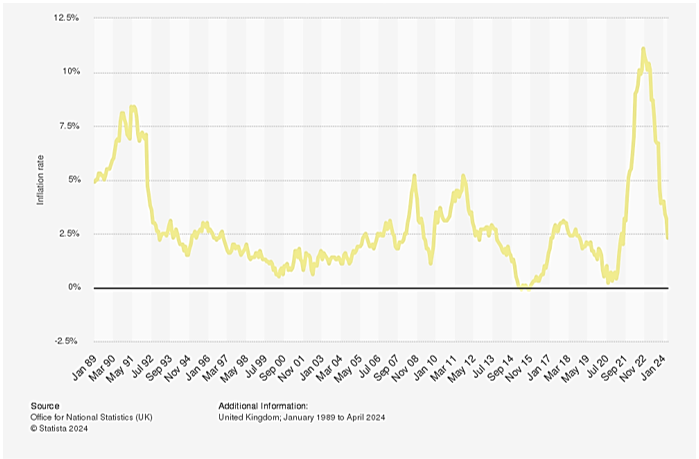
In more recent performance, the UK slipped into a recession (defined as two consecutive quarters of negative GDP growth) in the second half of 2023, thanks in part to rising inflation and interest rates. Although inflation has eased from its October 2022 peak, the cost-of-living crisis is still present with real household disposable incomes still declining and are not expected to recover until 2025/26.
Figure 1: Inflation rate for the Consumer Price Index in the UK from January 1989 to April 2024
Alcohol consumption declines as prices increase
In the alcohol sector, inflation has remained high as a result of the change to the duty structure in late 2023. The price of total alcoholic drinks rose 5.9 per cent in May 2024, while the price of wine rose by 6.2 per cent. In comparison, the total UK inflation rate fell to 2 per cent in May 2024.
According to IWSR, alcohol consumption in the UK declined by 2 per cent in volume during 2023, which was a slight acceleration of the decline experienced in the previous five years (1 per cent per annum). The reduction in consumption was driven by the long-term moderation trend, which was amplified by cost-of-living pressures and on-premise outlet closures.
Wine and spirits suffered the most, declining by over 4 per cent year-on-year. Beer, which makes up over a third of all alcohol servings, declined as well, but at a slower rate. RTDs, though small, was the only category to grow – driven by new product development in pre-mixed cocktails – with their convenience and affordability appealing to consumers.
On 1 August 2023, a new alcohol taxation regime was introduced in the UK. In simple terms, it means that the duty applied to alcoholic drinks is linked to the amount of alcohol in the beverage – the higher the alcohol content, the higher the tax. A “temporary easement” was established for wines with an alcohol content between 11.5 and 14.5 per cent (which covers about 85 per cent of still wines) – where they are assumed to have an alcohol content of 12.5 per cent for the purposes of the tax rate. This easement is currently scheduled to be lifted in February 2025 – where up to 30 different duty brackets will come into force (see able 2 as an example). This will add a larger amount of complexity in getting wines into market and IWSR predicts that it will lead to price increases on 75 per cent of still wines. It is also anticipated that this change will encourage new product development in lower-alcohol brackets – to capitalise on the lower duty rates. In the off-trade market for the 12 months to June 2024, there has already been an increase in the volume of still wines sold below 11.5 per cent alcohol – moving from a 10 per cent share of the market to 12 per cent (Circana).
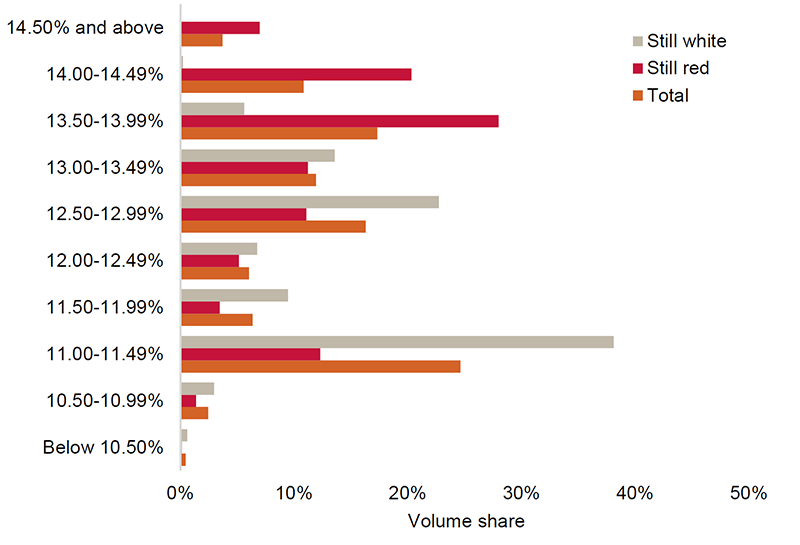
In 2023, over 50 per cent of Australian red wines exported to the UK were above 13.5 per cent in alcohol content, while only 22 per cent fell below 12.5 per cent alcohol. Meanwhile, 58 per cent of Australian white wines exported in 2023 contained below 12.5 per cent alcohol.
Figure 2: Share of Australian wine export volume to the UK by alcohol %
Source: Wine Australia
Wine consumption declines despite more wine drinkers
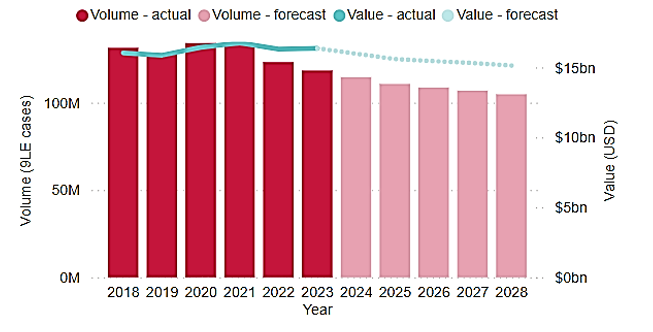
After experiencing a boost during the COVID-19 pandemic in 2020 and 2021, wine consumption in the United Kingdom has declined in volume in the past two years. This is largely seen as a market correction after the artificially high consumption during the pandemic years. However, consumption is forecast to decline a further 2 per cent per annum until 2028.
The forecasted decline is driven by a number of factors such as losing share amongst younger consumers, moderation trends, and declining disposable income. Despite this – the number of weekly wine drinkers has grown by 9 per cent compared with 2019, according to IWSR. These two trends – declining volume but increasing wine drinkers – translates to lower consumption per consumer. Per capita wine consumption has been on a downward trend in the UK since peaking at 27.6 litres per adult in 2007. Adults in the UK consumed 19.6 litres each in 2023.
Figure 3: Volume and value of wine consumption in the UK
Source: IWSR, via the Market Explorer
No-alcohol wine more popular than low-alcohol
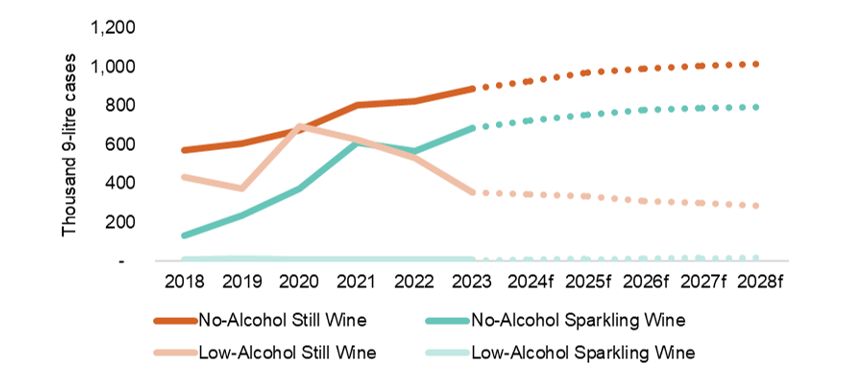
About 50 per cent of the UK population purchased no or low alcohol products in 2023 – and 44 per cent of these consumers purchased no or low wine (up 7 percentage points from the previous year). In the UK, no alcohol wine has a sizeable market share – and it’s growing. 81 per cent of low or no alcohol wine sold in the UK is no-alcohol, and volume has grown 17 per cent on average in the last five years. Conversely, low-alcohol products have a larger market share than no-alcohol in markets such as the United States, Canada, and Australia.
Figure 4: Volume of no-and-low alcohol wine sales in the UK
Source: IWSR
On-premise recovery impeded further by cost-of-living concerns
The share of off-premise vs on-premise wine consumption in the UK has not returned to the pre-COVID “normal.” During 2020, on-premise consumption fell from 14 per cent to 6 per cent of volume, and this share has only recovered to 10 per cent in 2023.
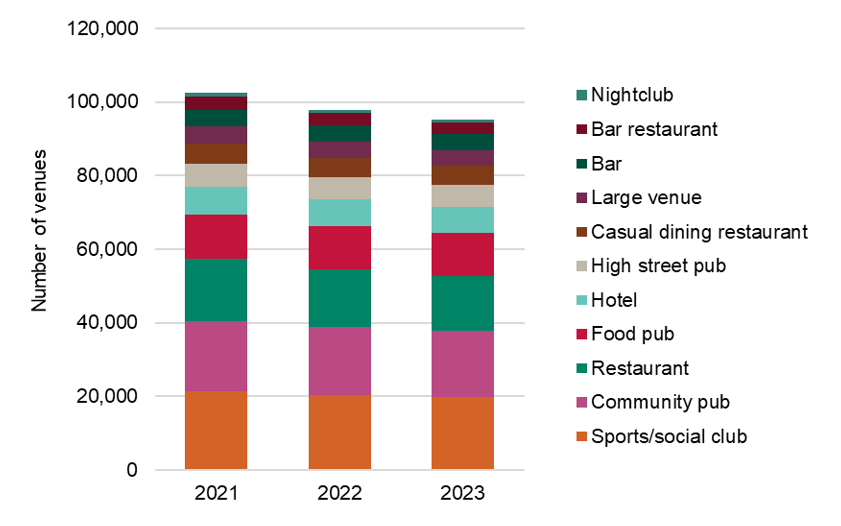
Due to rising costs and changes in consumer behaviour, nearly 3,000 licensed venues were closed during 2023 (on top of the nearly 5,000 which were lost in 2022) – with the largest loss being felt in restaurants (CGA). Bars and nightclubs make up a smaller number of venues but were also heavily impacted due to younger drinkers increasingly opting to “pre-drink” at home or forego midweek visits to save money.
Figure 5: Number of licenced food and drink venues in Great Britain
Source: CGA
Recent Australian export performance driven by turbulent events in the UK
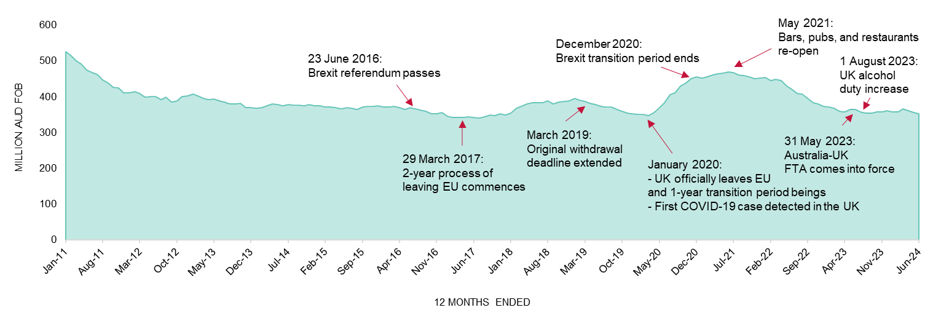
Australia’s export performance to the United Kingdom in the last eight years has been heavily impacted by large shifts in policy. In June 2016, 52 per cent of voters in the UK nominated to leave the European Union, and thus began what turned out to be a nearly five-year process of separation. During these five years there were periods of elevated shipments to get product into market ahead of new complications at customs – see 2018 and 2020 in Figure 6 – and roughly equal counter-swings after the fact.
The second major event affecting exports to the UK was the COVID-19 pandemic. Australia is the number one source of wine in the off-premise channel and therefore benefitted from at-home consumption and pantry loading. When bars and restaurants re-opened in 2021, Australian wine exports to the UK declined.
On 31 May 2023, as part of the Australia-UK Free Trade Agreement, import tariffs on Australian wine were eliminated. However, the increase in duties as part of the alcohol duty reform meant that the benefits to Australian wine exporters from this agreement were short-lived.
Figure 6: Value of Australian exports to the United Kingdom
Source: Wine Australia
For more analysis on Australian export performance and more trends in the UK wine market, please read the full Market Update: United Kingdom report.
Resources for Australian wine exporters
There are several resources available through the Wine Australia website for current or prospective exporters.
Public access:
- Export Dashboard - headline figures for the latest release of data, as well as detailed statistics on wine exports by destination market, GI claim, variety, wine style, container type, and exporter size.
- Market Explorer - shows where wine is consumed and how much, which markets are showing growth in wine consumption, the share of on-trade versus off-trade, and what share of that consumption is Australian wine. It incorporates data from The IWSR for wine consumption, along with key economic indicators.
- FOB to retail calculator - allows users to calculate what the bottle price will be on shelf (the RRP) in international markets for a given FOB value
Levy-payer and exporter access only:
- UK Landscapes - provides an overview of the consumption behaviour and attitude towards imported and domestic wine among regular wine consumers in the UK market.
- Export Market Guide - All regulatory information for exporting wine goods to the United Kingdom including the regulatory environment, duties and taxes, and permitted additives.
For more data and insights on the United Kingdom wine market – please book an “Ask an Analyst” session.


