



The relationship between Australia and New Zealand is arguably most famous for its sporting rivalries. However, less well known is the influence that the exchange of wine between the two countries has had on each other’s wine markets, which are closely intertwined.
This Market Bulletin will examine the two wine markets, how Australia’s exports to New Zealand have evolved over recent years and the current consumer preferences in New Zealand.
Shared connection in wine
Australia and New Zealand are both key wine producing nations on the global stage. In 2023, Australia produced around 964 million litres in 2023 (a 4 per cent share of global wine production) and New Zealand produced around 360 million litres (less than 2 per cent of wine produced globally). While these are small shares on a global scale, the reciprocal relationship between Australia and New Zealand when it comes to consuming each other’s wine is significant.
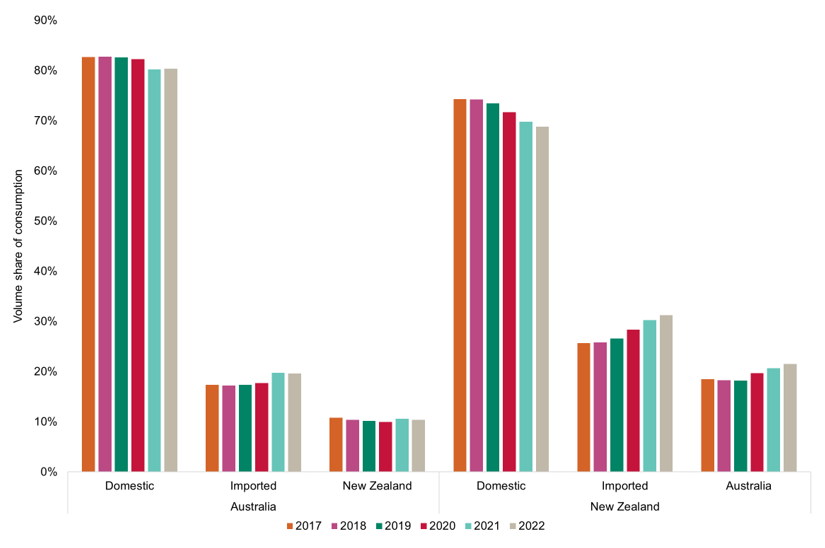
Both countries are the number one imported source of wine in each other’s market, giving them a strong competitive advantage. Domestic wine consumption has declined in both Australia and New Zealand in recent years (see Figure 1), with imports taking a growing share of consumption by volume.
In the New Zealand market, Australia has been one of the drivers of the growth in imports – growing from 18 per cent in total market share in 2017 to 21 per cent in 2022.
However, in Australia, the story is different. The decline in domestic wine consumption is behind the increase in imported wine’s share of total consumption. The actual volume of imported wine consumed in Australia has been relatively unchanged over the past five years and the consumption of New Zealand wine has declined over that time period.
Figure 1: Wine market share by source, Australia vs. New Zealand
Source: IWSR
Exporters on the world stage
Both Australia and New Zealand export the majority of the wine that they produce – 58 per cent of Australian wine is sold overseas, while 85 per cent of New Zealand’s wine is exported. Similarly, the United Kingdom and the United States are the top export markets for both producers. Australia is New Zealand’s third largest export market by volume, while New Zealand is Australia’s fourth largest.
While Australian wine exports have been experiencing tough trading conditions for several years – as a result of the duties on Australian wine to mainland China, fluctuations in consumer behaviour due to COVID-19, and a general decline in wine consumption caused by consumer health concerns and competition from other beverages – New Zealand wine shipments have seemingly been immune to these forces.
One of the factors that has supported New Zealand’s exports is its position in many markets as primarily a premium white wine producer – a segment of the wine market that has, until recently, been very resilient to decline in consumer demand. However, as disposable incomes have become squeezed in 2023, there have been reports of consumers either trading down or trading out of the wine category altogether. At the end of 2023, New Zealand’s wine exports declined by 7 per cent in value and 10 per cent in volume[1].
Australian exports to New Zealand – a long-term view
Over the past decade, Australian wine exports to New Zealand have been relatively stable in volume (see Figure 2), while value has increased by 3 per cent on average per year during that time. Thanks to the stability in volume, New Zealand has moved from Australia’s fifth largest destination by volume to fourth since 2022 (as the volume of exports to Germany has declined).
Figure 2: Volume and value of Australian wine exports to New Zealand
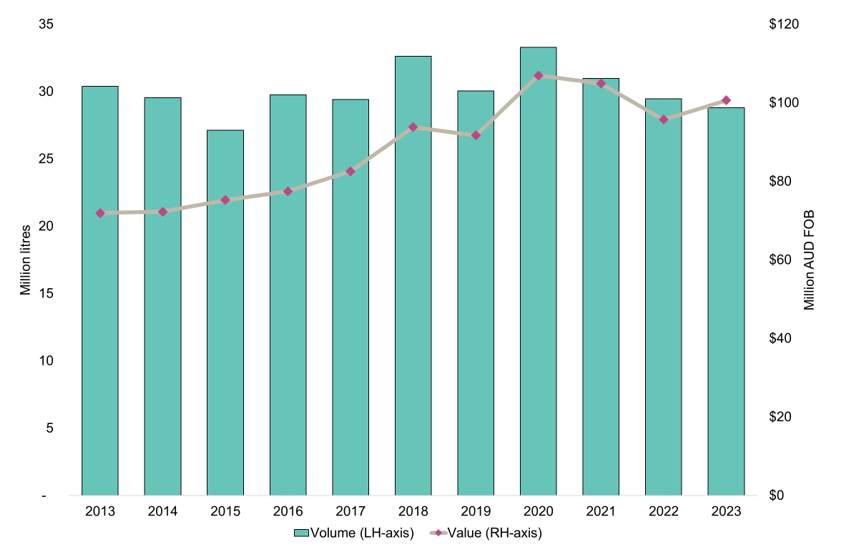
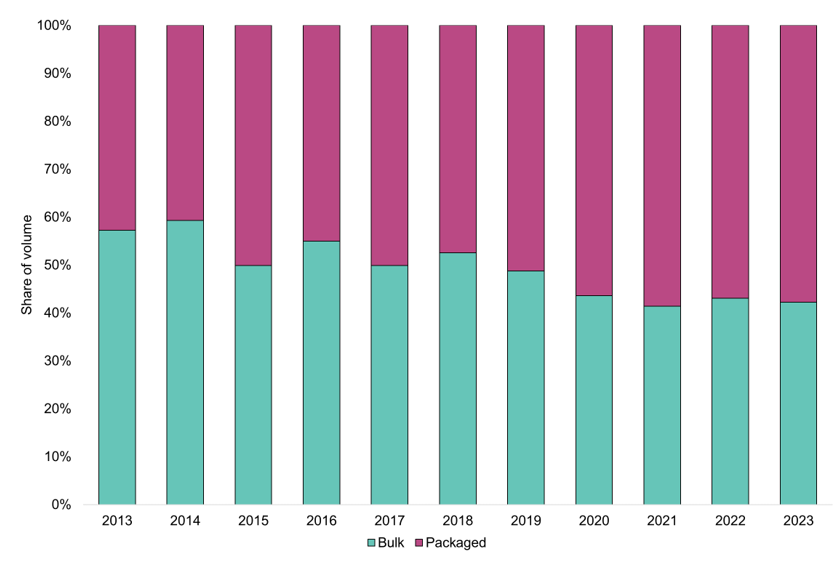
The fact that value has risen while volume has been stable has been driven by two trends – the first being the decline in unpackaged (bulk) wine shipments and the increase in packaged shipments. Over the past ten years the volume share of bulk and packaged shipments have effectively swapped (see Figure 3), with bulk wine having a 57 per cent share of volume of 2013 and dropping to 42 per cent in 2023.
Figure 3: Volume share by packaging type
Secondly, the volume of exports shipped at an average value of less then $5 per litre has declined (mostly driven by the decline in bulk wine shipments) while the volume shipped above $5 per litre has increased by an average of 5 per cent per year in the past decade, resulting in an increase in the average value of exports to New Zealand. This reflects the broader premiumisation trend occurring in developed wine markets globally; according to IWSR, premium wine sales (NZ$15 per bottle and above) in New Zealand have increased by 3 per cent per annum in the past 10 years, while the value/commercial segment (below NZ$15 per bottle) has declined by 2 per cent over the same period.
Red and white wine lose share to rosé
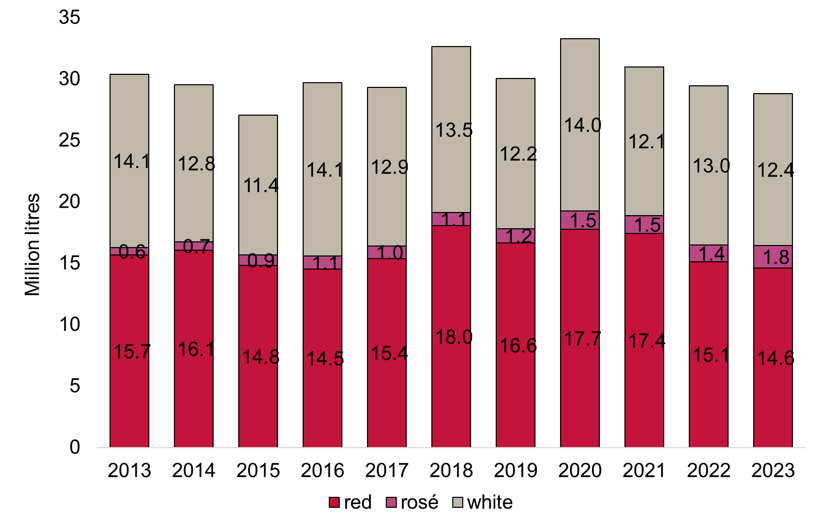
Most of what Australia imports from New Zealand is white wine and roughly 80 per cent of New Zealand’s vineyards are white wine varieties – 65 per cent of total plantings are Sauvignon Blanc. However, the wine that Australia sends to New Zealand is more evenly split in colour. In 2023, 51 per cent of Australian wine shipped to New Zealand was red, while 43 per cent was white. These shares are smaller than ten years ago as both colours have lost share to rosé wine.
The volume of rosé exported to New Zealand has grown by an average of 12 per cent per annum in the past decade, increasing its share of exports from 2 to 6 per cent. The increase is consistent with consumer trends reported by IWSR – where the proportion of regular wine drinkers in New Zealand drinking rosé grew from 39 per cent in 2017 to 45 per cent in 2023.
Figure 4: Exports to New Zealand by colour
Red and sparkling wines drive growth in 2023
In the 12 months to December 2023, Australian wine exports to New Zealand grew by 5 per cent in value to $101 million and declined by 2 per cent in volume to 29 million litres. Red and sparkling/carbonated wine drove the increase in value. For red wine, the growth came from exports valued above $2.50 per litre, with particularly good growth for Shiraz, Cabernet Sauvignon, and Pinot Noir across several price segments. Sparkling/carbonated wine grew by 30 per cent in value, with price segments below $10 per litre driving the growth. Prosecco, Moscato, and Chardonnay were the key growth varieties in this category – the Moscato growth in particular aligning with IWSR’s analysis that a larger proportion of regular wine drinkers in New Zealand are looking for sweeter and lighter-alcohol wines than previous years.
For more detailed export data, please visit the Export Dashboard.
[1]New Zealand Wine Export Report December 2023


