



A research team has developed a nanoengineered "smart surface" tool to selectively remove unwanted volatile sulfur compounds from wine.
Importantly, the technology has the ability to eliminate sulfidic off-aromas from wine while preserving desired tropical and 'gun flint' aromas – as well as maintaining sulfur dioxide (SO2) concentrations.
The breakthrough – part of an Impact project developed by the Australian Wine Research Institute (AWRI), innovation and commercialisation consultants Impact Innovation and Wine Australia – provides winemakers with an alternative remediation strategy beyond copper fining methods.
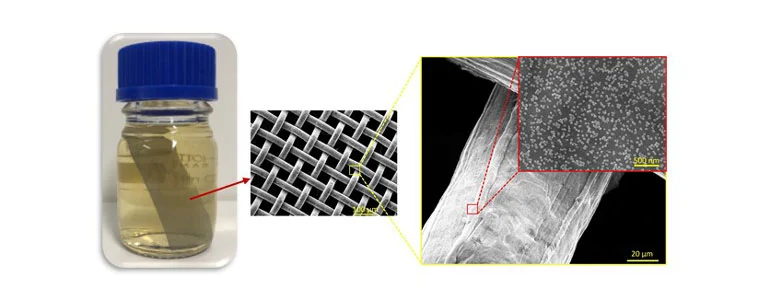
So how does the ‘smart surface’ technology work?
The novel nanoengineered surface technology involves applying a thin plasma polymer coating to a surface and then immobilising nanoparticles on the surface, which strongly bind volatile sulfur compounds from wine.
The smart surface can be applied to filtration devices and/or processing aids. It can also be applied as a smart scalping material inside screw cap closures or as part of packaging material in cans or bag-in-box wine packaging products.
“What sets this technology apart is its ability to outperform the traditional winemaking treatment of copper sulfate addition, commonly used to mitigate unwanted volatile sulfur compounds,” said project lead Dr Agnieszka Mierczynska-Vasilev, Principal Research Scientist at the Australian Wine Research Institute.
“For example, unlike copper sulfate, it does not negatively affect flavour. Our trials have shown that sulfur dioxide (SO2) does not interfere with the ability of the nanoengineered surfaces to remove hydrogen sulfide (H2S), and they do not remove tropical sulfhydryls. Both findings are significant.”
She said in contrast, when winemakers added copper to finished wine to remove sulfides, they also removed volatile thiols – potentially decreasing important 'tropical' flavours.
“Considering that tropical aromas are crucial for the stylistic expression of certain wine varieties, it is essential that these compounds remain in the wine.”
Dr Mierczynska-Vasilev said trials of the new technology had been shown to remove up to 80 per cent of free hydrogen sulfide from wine and were also effective at removing more complex sulfur compounds, such as methanethiol and ethanethiol.

“In comparison, typical copper treatments do not remove methanethiol and ethanethiol from treated wine. Additionally, we found that a fraction of strongly bound sulfhydryls could not be removed with traditional copper fining, but could be removed with nanoengineered surfaces.”
Dr Mierczynska-Vasilev said the smart surface technology offered potential applications beyond wine treatment. “It could also be applied to wine equipment such as filtration devices, aerators, decanters, and packaging material such as canned wine.
Want to learn more?
Wine Australia is working closely with the AWRI and innovation and commercialisation consultants Impact Innovation to apply a new approach to project development that assesses the paths to realising value from research and co-designs solutions with partners.
You can read more about the process here.


