



In the last two months, one of Australia’s key export markets has been caught in an accelerating trade war. Canada is the fourth largest export market for Australian wine, representing 10 per cent of volume exported in 2024. This Market Bulletin will give you a rundown of the most important things to be aware of when considering the Canadian wine market in 2025.
In summary:
- Wine consumption is declining due to health and cost-of-living concerns, in line with other mature markets.
- Most wine is sold through liquor boards – but this is changing.
- The competitive environment between imported and domestic wine has been stable – but turmoil in trade relations could change this.
- Australian wine export performance is heavily influenced by market trends in Quebec and Ontario – where over two-thirds of Australian wine is sold.
It is important to be keep in mind that it is a rapidly evolving trade environment, and risk mitigation for Australian wine exporters is paramount. Any export strategies should include market diversification, playing to your brand strengths, and capitalising on opportunities as they present.
1. Wine consumption is declining due to health and cost-of-living concerns, in line with other mature markets
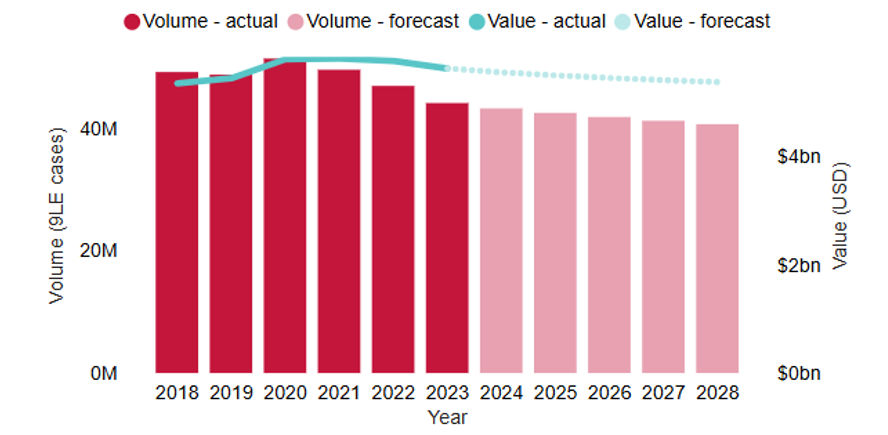
The Canadian wine market is ranked as the second-most attractive wine market globally by IWSR. In 2023, 44 million cases of wine were sold, worth US$5.6 billion, putting it just below the Chinese market in both volume and value. After a bump in wine consumption during the COVID-19 pandemic, wine sales in Canada have been on a downward trend, declining by 6 per cent in volume in 2023 (see Figure 1). However, there are some signs this decline may be stabilising, with preliminary data for 2024 showing little change year on year.
Figure 1: Volume and value of wine consumption in Canada
Source: IWSR, via Wine Australia’s Market Explorer
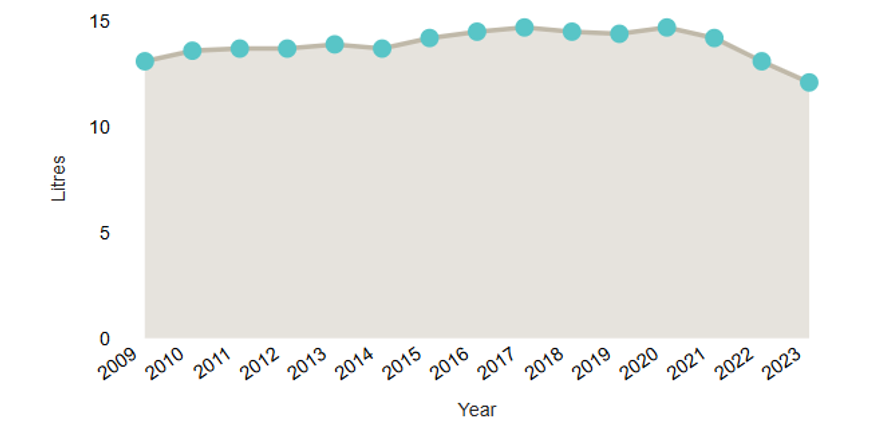
The decline in wine consumption, like many established markets around the world, is driven by consumer moderation due to health and cost-of-living concerns. Between 2021 and 2023, per capita wine consumption fell by 8 per cent each year – shrinking from 14.2 litres per adult per year to 12.1 litres (see Figure 2).
Figure 2: Adult per capita wine consumption in Canada
Source: IWSR, via Wine Australia’s Market Explorer
Research on Canadian wine drinkers by IWSR indicates that there is a split between generations when buying wine – with younger generations (Gen Z and Millennial) reporting buying more and older generations buying less (Gen X and Boomer). However, Millennials and Gen Z only make up 42 per cent of regular wine drinkers so are unable to offset the volume decline resulting from older generations. All generations report that they are buying cheaper wine by buying on promotion or down-trading.
Of those who are drinking less wine, the number one reason is reducing their alcohol consumption overall, followed by financial concerns around reducing spending and rising wine prices. However, those wanting to reduce wine consumption are still unlikely to choose a low alcohol wine, with only 10 per cent of wine drinkers using this as a substitute.
2. Most wine is sold through liquor boards – but this is changing
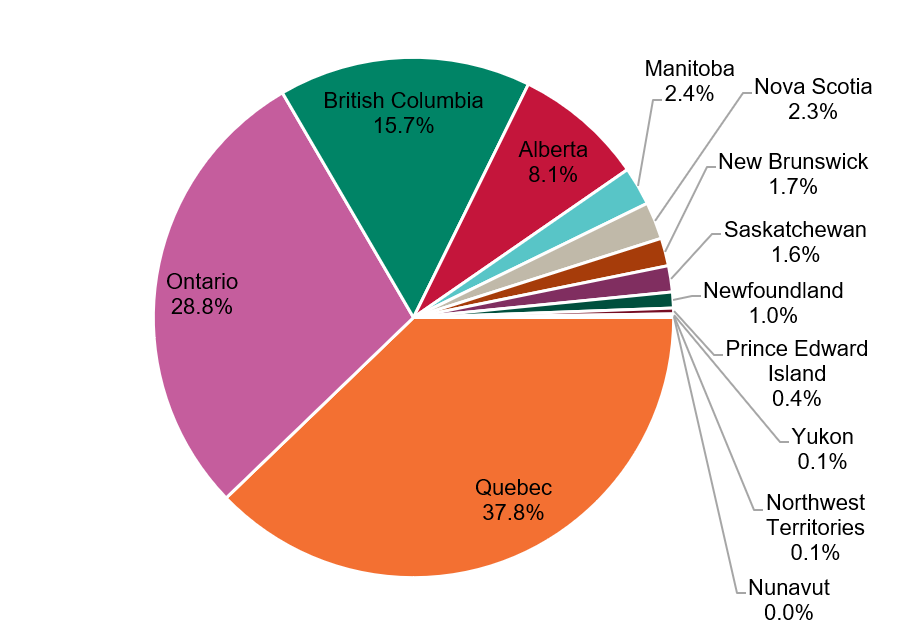
All but one of Canada’s 13 provinces have liquor sales that are regulated by government monopolies. Apart from Alberta, which privatised liquor sales in the 1990’s, most of the Canadian population purchases wine through government outlets. The three largest provincial agencies are the British Columbia Liquor Distribution Branch (BCLDB), Société des alcools du Québec (SAQ), and the Liquor Control Board of Ontario (LCBO). Each agency’s controls and responsibilities vary slightly but they are all the main gatekeepers to wine consumers in Canada representing 82 per cent of volume sold in Canada (see Figure 3).
Figure 3: Volume share of wine sales by province in Canada
Source: Association of Canadian Distillers, 12 months to December 2024
In recent years laws have been relaxed in some provinces to allow for liquor sales in grocery and convenience stores. According to IWSR, in 2024, 62 per cent of regular wine drinkers have bought wines in government-controlled outlets, down from 69 per cent in 2019. For example, in 2023 the government of Ontario announced plans to increase the number of outlets allowed to sell beer, wine, cider, and RTDs (not spirits). In late 2024 these changes started to roll out across grocery, convenience, and big-box stores in Ontario. IWSR estimates that this will add around 8,500 retail locations for alcohol and make it more accessible to Canada’s most populous province. The LCBO will act as the wholesaler to these new retailers, and as such, the products available in these outlets must have commercial listings with the LCBO.
3. The competitive environment between imported and domestic wine has been stable – but turmoil in trade relations could change this
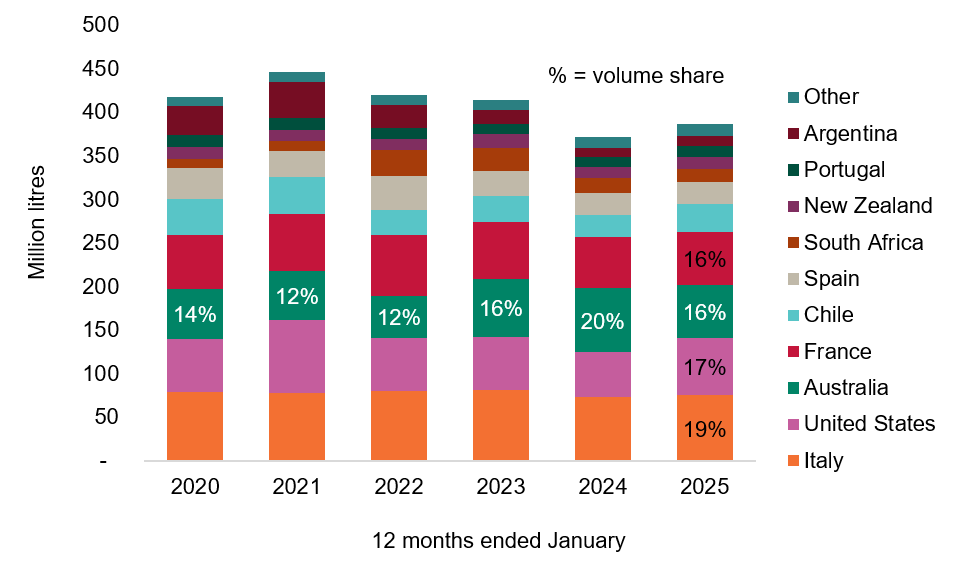
Canada is the most popular source country amongst Canadian wine consumers, with 54 per cent of regular wine drinkers having consumed Canadian wine[1] in the last six months according to IWSR. Canadian wine sales represent 29 per cent of volume sold, a share which has been stable over the last five years, followed by the top four imported source countries of Italy, United States (US), Australia, and France. These four sources have a very similar share of imports by volume (see Figure 4). Over the last five years, total Canadian imports of wine have declined by 2 per cent on average per year with most of the decline driven by Argentina, Spain, and Chile.
In the 12 months to January 2025, Canadian wine imports grew by 4 per cent. Although this growth was driven by the US and Chile, this represented a return to more typical levels of shipments after an unusually low year in the 12 months to January 2024. Australian wine has experienced the opposite trend – growing to an unusually high share in 2024 before returning to more normal levels in 2025.
Figure 4: Canadian wine imports by source country
Source: Trade Data Monitor
Recent developments in the trade relationship between the United States and Canada may alter this typically steady operating environment for wine imports and domestic wine production.
On 4 March 2025, US President Donald Trump imposed tariffs on Canadian and Mexican goods entering the US. On 12 March 2025, additional tariffs on steel and aluminium products from all importers (including Canada) were imposed. In retaliation, Canadian government has imposed two rounds of tariffs – the first of which, on 4 March, included wine. Wine imported to Canada from the US is now subject to a 25 per cent tariff, where previously it entered Canada tariff free under the United States-Mexico-Canada Agreement (USMCA). Additionally, most of the liquor monopolies have instructed outlets to remove American alcohol products from their shelves.[2]
While this situation may result in some opportunities for Australian wine to increase sales in Canada, the reality is that orders from Canadian liquor boards have long lead times.
Wine Australia’s Regional General Manager Americas, Aaron Ridgway said, “Liquor board fulfilment timeframes are typically 12-18 months from the placement of a purchase order to the product(s) appearing on shelves. Exact timings may vary – existing wines may arrive sooner than new listings, and shipping timelines tend to move around. These long lead times make it very difficult for Australian wine to benefit from the sudden delisting of wine from other origins.”
4. Australian wine export performance is heavily influenced by market trends in Quebec and Ontario – where over two-thirds of Australian wine is sold
Around 4 million cases of Australian wine were sold in Canada in 2024 – an 8 per cent market share. Over the last five years, Australian wine exports to Canada have declined by 3 per cent per annum in value, while growing by 3 per cent in volume. This trend has mainly been driven by a decline in mainstream commercial wine brands (in line with the overall market trend of declining consumption mentioned above). At the same time Australian bulk wine has been very competitively priced and therefore been sourced at an increasing level in international blends sold in many outlets across Canada.
The largest province for Australian wine sales is Quebec, with a 47 per cent volume share (see Figure 5). Most Australian wine sold in Quebec is through grocery stores, rather than SAQ outlets. The large increase in Australian bulk wine shipped to Canada in 2022/23 was driven by shipments to Quebec for grocery store brands and international blends.
Figure 5: Volume share of Australian wine sales by province in Canada
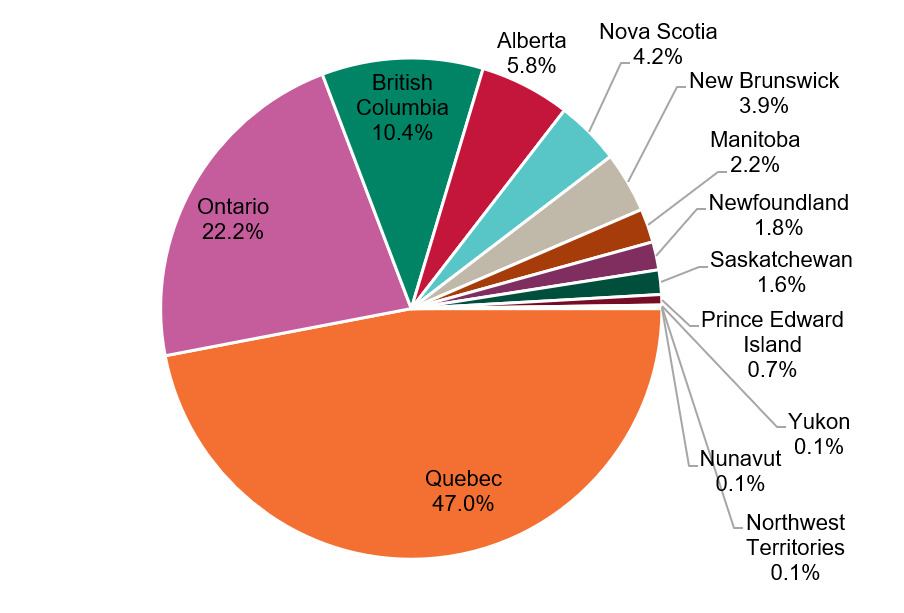
Source: Association of Canadian Distillers, 12 months to December 2024
However, turning to the last 12 months, shipments of bulk wine eased, and glass bottle shipments started to recover. In 2024, shipments of wine in glass bottles increased by 17 per cent in volume and 19 per cent in value. Most Australian glass bottle shipments are destined for Ontario and this province is also driving most of the increase in the last 12 months (although bottled shipments to Quebec also increased). It is possible that this is a result of the recent regulatory changes in Ontario allowing grocery, convenience, and big box stores to sell wine (as mentioned earlier in this article).
A large driver of the increase in bottled exports was the $7.50 to $9.99 per litre price segment (see Figure 6), which increased by 70 per cent in volume overall and doubled in shipments to Ontario specifically.
Figure 6: Volume by price point of bottled wine exports to Canada
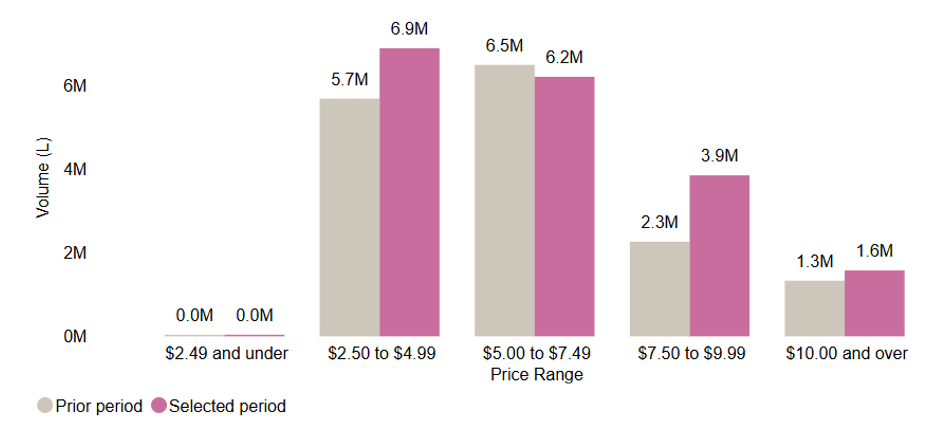
Source: Wine Australia’s Export Dashboard


