With agtech on the rise, it’s important for growers and viticulturists to have a better understanding of data and how it can be managed.
“That’s not easy and many businesses struggle with it, but knowing what constitutes data and how it can best be managed can help bolster productivity and profitability,” said 2021 Nuffield Scholar, Hans Loder.
Hans used his Wine Australia-supported scholarship to examine practical aspects of data collection and management for the Australian wine sector, his project entitled, “Here come the robots, but what do we do with the data?”
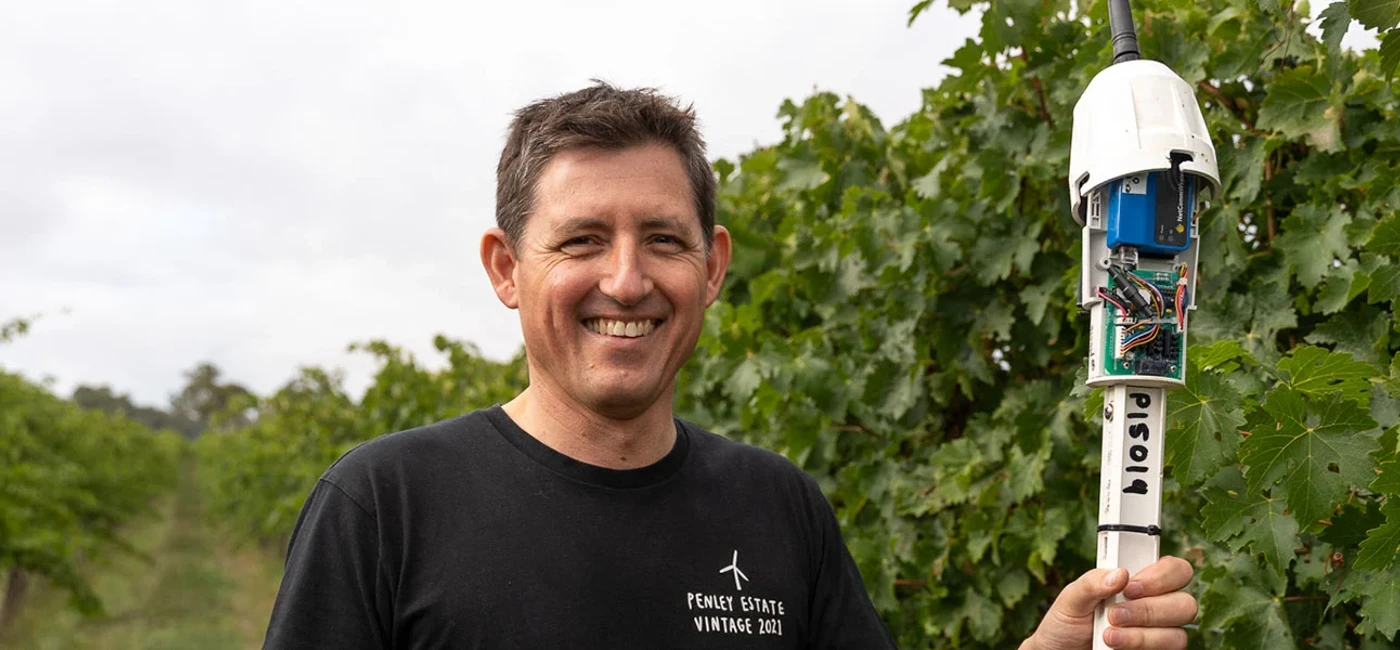
As viticulturist at Coonawarra’s Penley Estate, responsible for implementing precision viticulture and agtech initiatives, Hans was particularly focused on identifying efficient data management and storage pathways that allow data to be more easily accessed, interrogated and analysed.
“At the moment, there is a lot of interest from Australian viticulturists in vineyard data collection and management but a lack of knowledge and tools available to break data out of silos [and] then convert it into broader insights and applications,” said Hans.
“My project looked to explain what constitutes ‘data’ and how it can be best managed. It turns out that there are different types of data and that it can occur in different forms; so can a business be confident it’s looking at the right data, all the data, let alone understand its level of data maturity?”
To get insights on this, Hans’ Nuffield journey led him to visit a broad range of businesses around the globe that collect, store and present not only agricultural data, but that generated by farms, factories, mines and even cities.
He said Australia was a world leader in terms of data, and he was able to visit a range of data-centric businesses that service industries such as mining and urban infrastructure, through to centres of excellence such as the QUT Centre for Data Sciences in Brisbane. He also visited the AVEVA Unified Operations Centre in London and UC Davis Winery facility and digital twin in California.
Hans said a key learning from his project was that every business is in some way grappling with the issue of data and how it can best be managed.
“Sure, some are doing better than others, and that will always be the case. But it’s helpful to understand that all businesses – whether they are large or small – have the capacity to not only measure their data maturity, but also to increase it. This is not only helpful for data traceability and reporting of Environmental, Social, and Governance (ESG) criteria, but also to facilitate continual improvement and create a strong business value.
“Often, growers may feel lost in terms of data, its management and the terminology around it. I’ve felt that opportunities have been missed as vineyard managers and data managers struggle to find a common language; or understand what can be achieved once the correct systems are in place.
Hans said knowing what to ask for was a key to moving forward. “For example, knowing and understanding the differences in roles between data engineers and analysts (to name only two) – and who best to ask for help in setting up robust systems – is an important first step.”
Hans said in most cases there was not a ‘one size fits all’ solution for data management.
“In my opinion, aggregation of data is likely best undertaken by individual businesses who can develop customised solutions that fulfil their needs.”
“Growers will be able to realise the value of their data as they’re required to consider what they collect, what is of value and what could add value if combined with other data. An investment of time to determine which systems work best to streamline data management and its interoperability within a business, will provide dividends in the future for growers as AI, machine learning and other tech become more common place in the sector.”