


With a wet 2022 vintage on the horizon, the message to growers is to remain vigilant for bunch rot.
“Monitoring the vineyard on a regular basis for disease incidence is of paramount importance, but in some vintages Botrytis bunch rot is hard to avoid, particularly when rain falls close to harvest,” said Christopher Steel, Professor of Viticulture at Charles Sturt University.
In a recently completed research project, Prof Steel investigated techniques to give growers more reliable tools for early Botrytis detection.
The findings will allow growers to make harvest decisions around the time of harvest – or in extreme cases, if to harvest the crop at all.
Prof Steel and his team defined thresholds for bunch rot contamination of wine grapes by measuring the amount of fungal biomass present in a batch of grapes – and then vinifying the grapes.
Sensory analysis of the subsequent wine was then completed to determine thresholds for a noticeable loss of wine quality.
“From this we were then able to estimate thresholds – based on the amount of fungal biomass detected in a batch of grapes – for Botrytis contamination.”
Working out how much fungus was present in a grape sample was achieved in two ways: by quantifying ergosterol, which is a fungal sterol only found in fungal cells (cholesterol is the equivalent sterol found in humans and other animals) and by measuring Botrytis antigens.
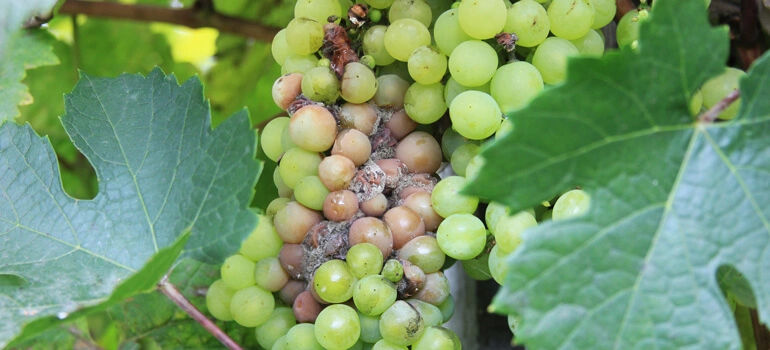
Image: AdobeStock
“The Botrytis antigen test uses a Lateral Flow Device, (similar to the types of devices that are used to measure other things including the COVID 19 virus) and is much more rapid than measuring ergosterol,” said Prof Steel.
The solutions will now be provided to winemakers to allow them to cope with situations where these thresholds have been exceeded.
“Measuring Botrytis antigens is a quick way to quantify the amount of Botrytis present in a batch of grapes with analysis times of minutes rather than hours or days. Using the device that we investigated, we were able to suggest threshold levels for Botrytis contamination.
“However, it is important to stress that our study investigated only two vintages and one grape variety, Cabernet Sauvignon. So further validation is warranted in a commercial setting.”
Aside from this, Prof Steel’s work compared several other methods for grey mould detection including gluconic acid assays and qPCR.
“Each of the techniques had limitations and advantages, so one recommendation for the wine sector is to use a combination of methods.”
Measuring ergosterol provided a direct measurement of fungal biomass, but was not as specific as measuring the Botrytis antigens.
“Furthermore, analysis of the ergosterol content of a batch of grapes requires an analysis time of approximately two days. Quantifying how much Botrytis is present in a batch of grapes by measuring the fungal antigens is the quickest and simplest assay to perform, taking minutes rather than hours to perform. At the moment the device that we used is not available for purchase in Australia, but hopefully this will change in the future.”
Prof Steel said while the results were largely as he anticipated, they provided some numbers around the theory.
“By providing better indicators of bunch rot thresholds, the sector can know with more certainty when fruit should be rejected or downgraded, which will enhance wine quality outcomes and improve the efficiency of vineyard management,” Prof Steel said.


