- Home
- Grapegrowing & Winemaking
- Pest & disease management
- Phomopsis cane and leaf spot

Phomopsis cane and leaf spot
Phomopsis cane and leaf spot is a fungal disease of grapevines caused by Phomopsis viticola. It occurs in most Australian grape-growing regions, although it has not been reported in Western Australia.
Why Phomopsis matters
Phomopsis can significantly reduce vineyard productivity when wet spring conditions favour disease development. While often considered a sporadic disease, Phomopsis can persist in vineyards for several seasons and become an ongoing management issue if not identified and controlled early.
For growers and viticulturalists, effective Phomopsis management relies on understanding seasonal risk, monitoring vineyards at critical growth stages, reduce carry-over inoculum by removing infected canes, spurs and prunings, and applying preventative fungicides before infection occurs.
Phomopsis primarily affects young shoots, leaves, canes and occasionally bunches. Severe infections can:
- Girdle and weaken shoots
- Reduce vine vigour and productivity
- Cause shoots to break under crop load or during windy conditions
- Lead to cane cracking and poor wood maturity
- Reduce yield through bunch stem infections and berry rot
- Create a long-term source of infection that carries over into future seasons
Because infections occur early in the season, damage is often done before symptoms become obvious. By the time leaf spots and shoot lesions appear, infection has already occurred and management options are more limited.
Understanding the disease cycle
The fungus survives over winter in infected buds, bark, canes and spurs. During spring, spores are released from infected wood and spread by rain splash onto newly emerging shoots.
Wet conditions are critical for disease development. The highest risk occurs when:
- Spring is cool and wet
- Rainfall events are prolonged
- Shoots remain wet for extended periods
- Vine canopies stay damp due to poor airflow
The fungus becomes relatively inactive during hot, dry summer conditions, but infected vineyards can continue to harbour inoculum for several years if sources of infection are not removed.
Identifying vineyard risk
Some vineyards are more vulnerable than others. Higher-risk situations include:
- Low-lying or sheltered blocks where moisture remains for longer
- Vineyards with poor air movement
- Dense canopies with prolonged leaf wetness
- Blocks with a history of Phomopsis infection
- Vineyards where infected canes or spurs are retained from previous seasons
- Mechanically hedge-pruned vineyards where infected canes remain in the canopy
Understanding these risk factors can help growers prioritise monitoring and management activities throughout the season.
Symptoms to look for
During winter inspect canes and spurs for:
- Bleached white areas on dormant wood
- Small black fruiting bodies (pycnidia)
- Longitudinal black cracks on canes
Bleached canes alone are not sufficient for diagnosis, as weather damage and other fungi can produce similar symptoms.
During spring and early summer watch for:
- Small dark brown leaf spots surrounded by yellow halos
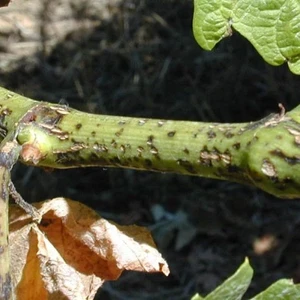
- Black lesions or elongated cracks on lower shoot internodes
- Distorted, stunted or weakened shoots
- Shoots that snap easily in wind or under crop load
In severe cases:
- Flower clusters may wither
- Bunch stems can become infected
- Berries may develop rot in cool, wet conditions
Monitoring and early detection
Monitoring is the foundation of effective Phomopsis management.
Most infections occur during or shortly after budburst, making early-season surveillance essential. Growers should not rely solely on visible symptoms later in the season.
Practical monitoring tips
Before budburst
- Inspect canes and spurs approximately four weeks before budburst
- Look for bleaching, cracking and black fruiting bodies
- Pay particular attention to blocks that showed symptoms previously
From budburst onwards
- Monitor susceptible blocks every one to two weeks
- Inspect around 200 shoots across representative vineyard areas
- Focus on lower leaves and lower shoot internodes where symptoms often appear first
High-priority areas
- Low-lying sections of vineyards
- Blocks with dense canopies
- Sheltered areas with poor airflow
- Sites with previous disease history
If long wet periods occur during flowering, inspect bunches and rachises for symptoms as the season progresses.
Management strategies
An effective Phomopsis program combines monitoring, cultural practices and, where necessary, targeted fungicide applications.
Only spray when risk exists
Preventative treatment is generally unnecessary where the disease is absent and risk is low.
However, where vineyards have a recent history of infection and conditions favour disease development, early season protective fungicide applications are often required from around 50% budburst to protect emerging shoots. Importantly, fungicides registered for Phomopsis are protectants rather than curatives and are most effective before infection occurs. Good spray timing and coverage are critical to ensure newly emerged shoots remain protected. Once symptoms are visible, infection has already taken place.
Improve vineyard hygiene
Reducing sources of inoculum can significantly lower future disease pressure.
Consider:
- Removing infected canes and spurs during pruning
- Avoiding retention of diseased wood as fruiting canes
- Removing or destroying infected prunings where practical
- Using clean propagation and planting material
Good sanitation reduces the amount of fungal inoculum available to infect new shoots the following season.
Manage canopy density
Canopy management plays an important role in reducing infection risk.
Practical approaches include:
- Reducing excessive vine vigour
- Maintaining open canopies
- Positioning shoots effectively
- Removing excess shoots or foliage where appropriate
- Improving spray penetration
- Encouraging airflow and faster drying after rain
These practices help shorten leaf wetness periods and create conditions that are less favourable for disease development.
Practical decision-making throughout the season
Timing | Key actions |
Winter | Inspect canes for bleaching and black fruiting bodies. Remove infected wood where practical. |
Pre-budburst | Review disease history and assess block risk. Prioritise monitoring of high-risk areas. |
Budburst to early shoot growth | Intensify monitoring, particularly after rainfall events. |
Wet spring periods | Consider protective management strategies where disease history and risk justify intervention. |
Growing season | Maintain an open canopy and continue monitoring for symptoms. |
Pruning | Remove infected canes and avoid retaining diseased wood for next season's crop. |
Key takeaway
Phomopsis is primarily a disease of wet springs and vineyards with persistent sources of inoculum. The most effective management strategy is to understand risk early, monitor regularly from budburst onwards, reduce carry-over inoculum by removing infected canes, spurs and prunings, and use preventative fungicides before infection occurs. Early action is critical because infections occur before symptoms become obvious, and preventative measures are far more effective than responding after disease development.

References and resources
Phomopsis cane and leaf spot management factsheet
Related projects
See allRelated topics
-

Eutypa dieback and grapevine trunk disease
Grapegrowers -

Downy mildew
Grapegrowers -

Powdery mildew
-

Mealybugs
-

Non-botrytis bunch rots
-
Grapevine viruses
-
Phylloxera
-

Botrytis bunch rot
Grapegrowers -
Nematodes in vineyards
-
Light brown apple moth
-

Grapevine Pinot Gris virus
Grapegrowers -
Grapevine scale and sooty mould