
Skip to main navigation Skip to main content

This site uses cookies

We use cookies and other tracking technologies to improve your browsing experience on our website.
Planting material

Grapevine breeding

Developing grapevines for Australia’s future

Grapevine breeding develops new varieties and rootstocks with characteristics that can help Australian vineyards respond to changing production conditions, pest and disease pressures and a changing climate.

Wine Australia has a long-standing research partnership with CSIRO focused on developing and evaluating improved grapevine material for Australian conditions. Current research includes mildew-resistant winegrape varieties, rootstocks with durable pest resistance and improved salinity tolerance, and gene-editing technologies that could introduce desirable traits into existing premium winegrape varieties.

Together with evaluation, germplasm management and access to healthy, true-to-type planting material, this research is intended to provide the sector with a broader range of planting options for future vineyards.

Grapevine breeding in Australia

Australia has a long history of grapevine breeding and evaluation.
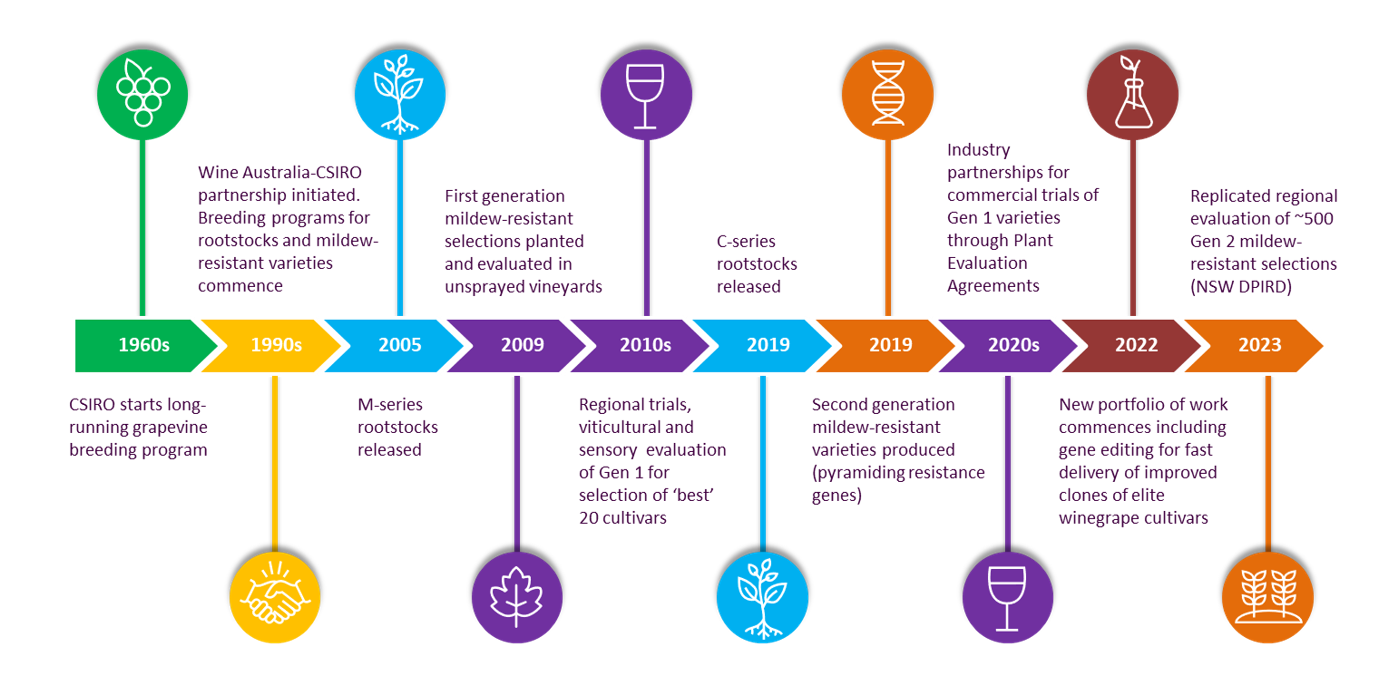
Key achievements in grapevine breeding in AustraliaKey achievements in grapevine breeding in Australia

CSIRO began winegrape research in the 1960s at Merbein in Victoria. Its work included importing grapevine varieties, clones and rootstocks and establishing a diverse germplasm collection. Over subsequent decades, breeding and selection programs investigated thousands of breeding lines to develop wine, table and dried grape varieties suited to Australian growing conditions.

Early winegrape breeding focused particularly on performance in warm irrigated regions and characteristics such as colour, acidity, flavour and wine style.

A number of winegrape cultivars were released through this program:

VarietyYear of releaseLink

Tarrango 

1975

Tarrango - CSIRO

Taminga (W)

1982

Taminga - CSIRO

Cienna     

2000

Cienna - CSIRO

Rubienne 

2000

Rubienne - CSIRO

Tyrian 

2000

Tyrian - CSIRO

Mystique

2017

Mystique - CSIRO


The CSIRO germplasm collection at Irymple, Victoria, remains an important industry asset and contains a substantial diversity of grapevine material.

Breeding for pest and disease resistance

More recent breeding has placed greater emphasis on improving the resilience of grapevines to some of Australia's major vineyard threats.

Wine Australia's co-investment with CSIRO has supported the development of winegrape varieties with resistance to powdery and downy mildew. This work produced around 1,200 first-generation mildew-resistant plants, from which leading red and white selections were progressed through further evaluation.

First-generation selections have been available for larger-scale industry field trials since 2019. Current work is focused not only on evaluating their performance, but also on addressing the practical pathway from research material to propagation and commercial use.

Second-generation material is also being evaluated. These vines combine multiple resistance genes with the aim of providing more durable resistance than first-generation material. More than 500 individual Gen 2 vines are currently undergoing field evaluation at Griffith and Orange in NSW.

Developing better rootstocks

Breeding is not limited to the fruit-producing part of the vine. Rootstocks are another major area of research.

Current Wine Australia and CSIRO research is developing second-generation rootstocks with durable resistance to phylloxera and root knot nematodes, together with improved salinity tolerance and traits that could increase resilience under changing Australian growing conditions.

This research complements the wider work to give growers access to healthy, true-to-type planting material and a greater choice of material suited to different vineyard conditions.

Gene editing and the next generation of grapevines

New breeding technologies provide additional ways of improving grapevines.

Current research with CSIRO is developing DNA-free gene-editing technologies and investigating their application to existing premium winegrape varieties. Rather than necessarily creating an entirely new variety through conventional crossing, this research is investigating specific genetic changes associated with production, disease or quality characteristics.

More than 200 gene-edited grapevine lines are currently being maintained within the research pipeline. These remain research material rather than commercially released grapevines.

The research forms part of Wine Australia's current five-year strategic research agreement with CSIRO, which runs to 30 June 2027

From breeding to the vineyard

Developing promising material is only part of the process. New grapevines also need to be evaluated under Australian conditions and supported by reliable pathways for propagation and industry access.

This connects grapevine breeding with Wine Australia's National Grapevine Collection program, which works with grape and wine producers, the propagation sector and research partners. Its activities include strengthening grapevine standards through VitiCert and identifying reliable sources of healthy, true-to-type material.

Regional field evaluation is also important. It provides evidence about how new material performs under different growing conditions before growers make long-term planting decisions.

Member content

This content is restricted to wine exporters and levy payers.

Reports are also available for one-off purchase to non-members.

Click here to find out more.